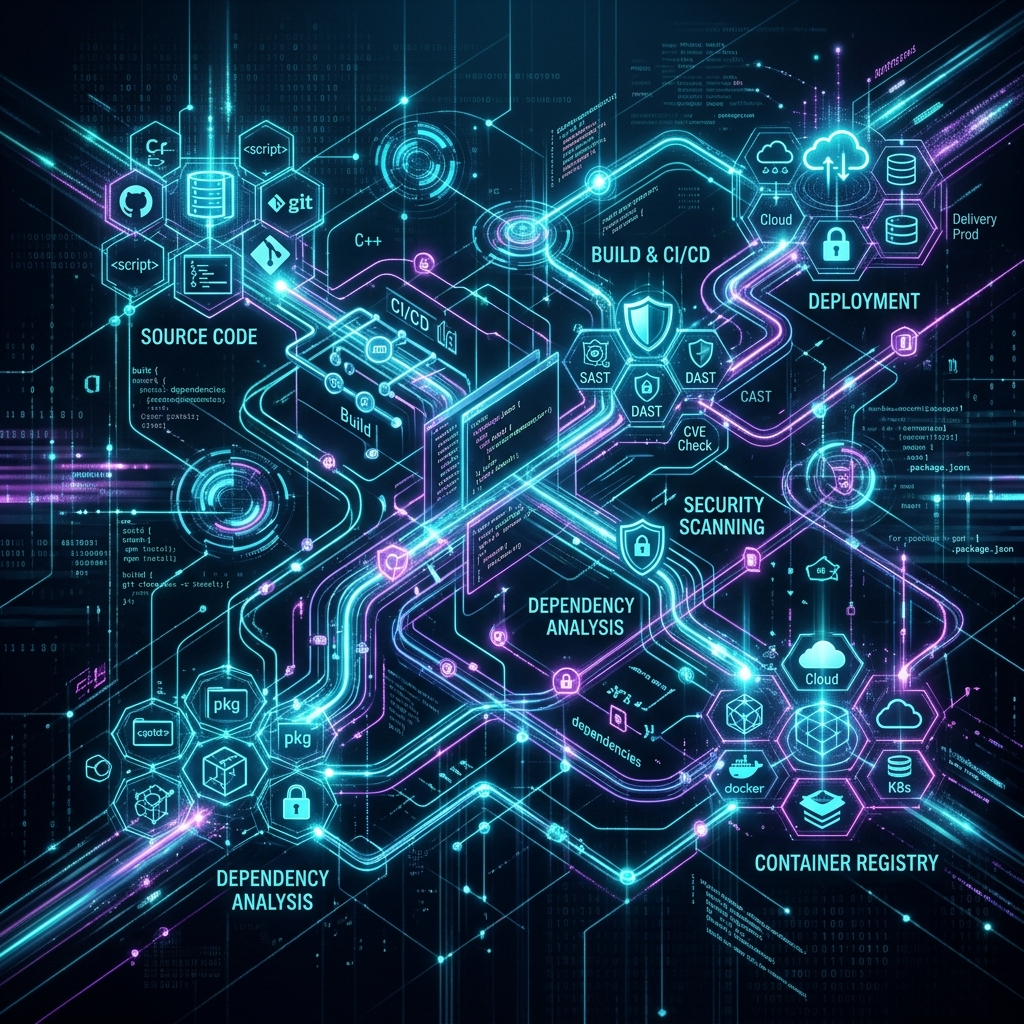
The modern software development lifecycle is more complex than ever. We no longer write 100% of our code; we assemble it from thousands of open-source building blocks. This reliance on third-party dependencies has created a massive new attack surface: the Software Supply Chain.
The Anatomy of a Supply Chain Attack
A supply chain attack doesn't target your production server directly. Instead, it compromises a tool or a library that you trust. Whether it's a malicious dependency update or a compromised build runner, the goal is to inject malicious code into your artifact before it ever reaches your infrastructure.
# Example: Verifying SBOMs in GitHub Actions
name: Supply Chain Security
on: [push]
jobs:
  secure-build:
    runs-on: ubuntu-latest
    steps:
      - uses: actions/checkout@v3
      - name: Generate SBOM
        run: syft . -o cyclonedx-json > sbom.json
      - name: Attest Build
        run: cosign attest --key cosign.key sbom.json
The SLSA Framework
To defend against these threats, the industry is gravitating toward SLSA (Supply-chain Levels for Software Artifacts). SLSA is a set of incremental security standards that help you reach "Build Integrity." By reaching SLSA Level 3, you ensure that your artifacts are built on non-falsifiable, ephemeral build runners with verifiable provenance.
# Verifying artifact provenance with Cosign
cosign verify-attestation --type slsaprovenance \
  --certificate-identity "https://github.com/aegix/core/.github/workflows/release.yml" \
  ghcr.io/aegix/core:latest
Core Principles of Hardening
- Immutable Infrastructure: Use ephemeral build environments that are destroyed after every run. This eliminates "poisoned" runners that persist across builds.
- Dependency Pinning: Never use "latest" tags. Pin every dependency by its unique SHA-256 hash. This prevents dependency confusion attacks where a malicious actor pushes a version-bumped package with the same name.
- SBOM Generation: Use tools like Syft or Trivy to generate a Software Bill of Materials. If a new vulnerability is discovered in an obscure library, you can instantly search your SBOMs to see if you're exposed.
By treating your build pipeline as a production environment, you can ensure that the code you ship is exactly the code you intended to write.